
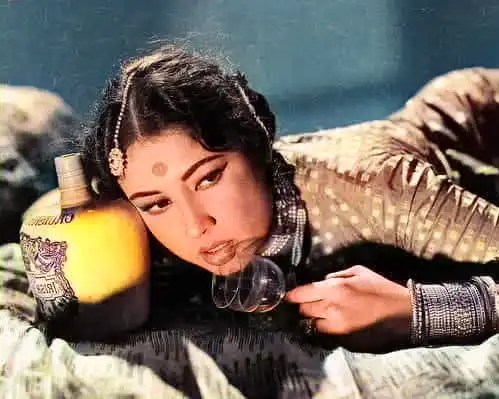
Meena Kumari as Chhoti Bahu in Sahib Bibi Aur Ghulam
I didn’t grow up watching Meena Kumari, nor did I grow up reading her poetry, but reading her words on a day like this, it feels as though I did. Her desperate yearning for love and approval is something that also plagues my heart, a feeling so honest, it hurts. Watching Meena Kumari in Sahib Bibi Aur Ghulam for the first time, her charisma shone through the colourless black and white lens. In that scene, I saw why they call you the tragedy queen.
Meena Kumari, a Bollywood Actress-Poet who starred in masterpieces such as Pakeezah, Kaajal and Sahib Bibi Aur Ghulam. She was one of the highest-paid actresses of her time, and her sorrowful performances earned her the name Tragedy Queen. But it wasn’t just a name; it was her life. From a child to a star to a poet, tragedy has followed her.
Her Life
Mahjabeen Bano, who later adopted the stage name Meena Kumari, was born in 1933 to Ali Bux and Iqbal Begum. Her father saw her as a great disappointment, as he had wanted a son. This set the tone of her life, Meena Kumari’s first fracture. Living in poverty in Mumbai, she was thrust into the film industry to support her family financially at the age of four.
Despite her lack of education, a quiet companionship with words was formed. She started to read the rhythms of Ghalib, and later Faiz Ahmed Faiz. By 1952, Meena Kumari rose to fame with Baiju Bawra. It was that same year her longing for love found a home with director Kamal Amrohi. They had met on the set of Tamasha, and she was hospitalised shortly after in a car accident. He visited her often in the hospital, and she was in love. They would marry in secret, hidden away from the press and her family, not a word echoed to anyone, not even to Kamal Amrohi’s first wife.
Her Tragedy
Although in secret, the news of Meena Kumari’s marriage would soon make its way to the papers and her father. The relationship between her and Amrohi drew many complications centred around obsession, possession, and aggression. Amrohi was controlling, dictating her every move. Her father never approved of her marriage, and her husband never truly approved of her. They would soon separate, but never divorce. At night, she was agonised by insomnia; her doctor prescribed a little brandy to soothe her to sleep. But soon, drinking became a habit, and then an addiction to escape.
Her Writing

On the sets of Benazair in 1964, she discovered poet Gulzar’s work. It was during this blackened time that she started to write under the pen name Naaz. Releasing an album of poetry in 1972. She once wrote:
Pyaas kuch is tarah lagi,
Ke zindagi bhar na bujhi,
Har saawan kuch kam pad gaya,
Har darya bekaar gaya
Such a thirst consumed me
That life itself couldn’t quench it
Every monsoon fell short
Every river proved useless

– Poem, Pyaas by Naaz
Reading her words, I’m hit by that yearning and despair that is often translated in her work. Her poetry was embroidered around love, loneliness, and sorrow, rarely capturing the sunlight, but the deepness of the night. Pyaas speaks of an unfulfilled longing that was present in her life, alongside a silent, empty isolation. These poems are more than beautiful words; they are her legacy, her life. Realness derived from her heart and her tears.
Due to her alcohol addiction, she passed away at the age of 38 from cirrhosis of the liver. But her words remain tender and still under the night’s moon.
This post is a personal reflection/Interpretations of Meena Kumari’s life, poetry, and experiences are my own, drawn from emotional resonance.
 Sunilswriting